
A Mission Rooted in Neuroscience
Guided by a founding commitment, powerful insights and novel scientific approaches, we're aiming to address some of the most complicated conditions.

Regeneron
September 25, 2026
For billions of people worldwide who live with a neurological disease,1 changes in muscle strength and function, movement and cognition can turn once-simple moments into daily challenges. Driven by the profound impact these diseases can have on patients, care partners and the clinicians who care for them, we are working to better understand these diseases and are committed to researching them:
- For adults living with generalized myasthenia gravis (gMG), their day-to-day lives are often unpredictable, ranging from intermittent symptoms such as fluctuating muscle weakness to fatigue, as well as severe exacerbations, including myasthenic crisis, a potentially life-threatening condition that can impair breathing.2
- Amyotrophic Lateral Sclerosis (ALS) begins as stiffness and weakness gradually leading to progressive loss of muscle control, taking away a person’s ability to live independently.3
- For people living with Parkinson’s disease, tremors and impaired movement can make once-routine activities, like buttoning a shirt or holding a cup of coffee, increasingly difficult.4
Regeneron’s Deeply Rooted Commitment to Neuroscience
The pursuit of finding answers to neurological diseases has been part of our story since the beginning.
Regeneron was co-founded by neurologist, Leonard S. Schleifer, MD, PhD, and scientist, George D. Yancopoulos, MD, PhD, with the original goal of “REGENErating neuRONs.” While working as a practicing neurologist and professor, Len became frustrated with the lack of effective treatments for patients with serious neurodegenerative diseases like Parkinson’s and Alzheimer’s. He wondered if new biotechnologies could be harnessed to potentially make an impact for these people, their families and many others. Meanwhile, George was inspired to pursue medicine and research fueled by his personal experience seeing his grandmother, affectionately known as Yaya, battle dementia.
These deeply rooted motivations drove our early research efforts, with our first investigational drug – a neurotrophic factor – entering clinical development in 1992. Decades later, that same drive continues to shape Regeneron’s vision: to deepen our understanding of these hard-to-treat neurological diseases through insights from human genetics and disease biology.

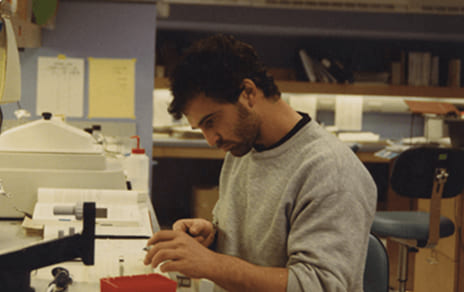
Len (left) and George (right) in the early days of Regeneron. The name Regeneron comes from “REGENErating neuRONS” with “gene” embedded in the middle, a reflection of the science that inspired our founding.
The field has faced ongoing challenges due to the inherent complexity of neurological conditions – how to bypass the blood-brain barrier and enter the brain, how to stop damage or, even better, restore function and what the right levers are to pull given the connected systems throughout our body – but is now on the cusp of exciting breakthroughs. Our scientists continued to deepen their understanding of the drivers of neurological diseases and the factors that influence how they develop and progress. Today, we are leveraging these insights to advance research using a range of emerging technologies, like small interfering RNA or siRNA across a myriad of neurological conditions.
What is siRNA and How Does it Work?
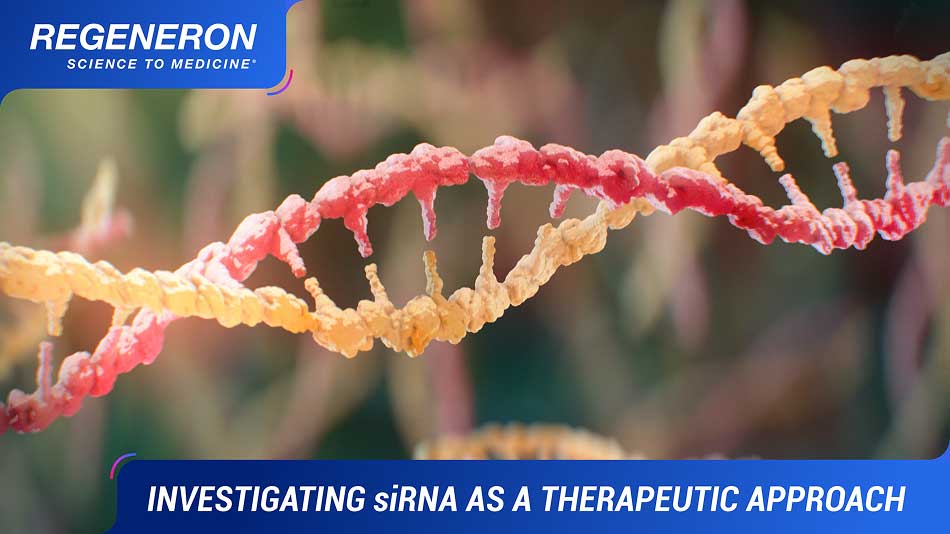
Our genes hold the instructions for making proteins, which are responsible for many of the body’s essential functions. These instructions are copied into a molecule called messenger RNA (mRNA). As the name implies, mRNA acts as a messenger, carrying instructions for the cell’s protein-making machinery.5
siRNA, or small interfering RNA, is a technology that can help control the regulation of certain proteins in the body by blocking the messages that tell cells to produce them. It uses a natural process in our cells known as RNA interference (RNAi), which helps control how much of a specific protein is made.6
Scientists can design siRNA molecules to find and attach to a specific mRNA message, with the potential to reduce production of the protein that message would have made.6 By targeting proteins we know are involved in disease, siRNA may offer a way to influence the biological pathways that contribute to those conditions – an area of research we are exploring through multiple efforts, including as part of a collaboration with RNAi pioneer Alnylam.
Unlike most traditional approaches that aim to reduce the activity of a protein after it is produced, siRNA can work earlier in the process, aiming to reduce production of the protein at its source by blocking the message that tells the cell to make it. Also, because one siRNA molecule can direct the breakdown of many copies of the target mRNA, its effects may continue after the drug has largely cleared from the bloodstream, potentially reducing how often treatment is needed. Importantly, siRNA acts in the cytoplasm (outside the nucleus), and therefore it does not modify or integrate into cellular DNA.6
siRNA is one of the tools we are applying in our effort to understand the biological processes that contribute to neurological diseases.
Note: This information is intended to describe the basic principles of siRNA based on the referenced literature and is not intended to convey therapeutic effect. In some cases, siRNA may interact with unintended transcripts due to partial sequence complementarity, potentially resulting in off-target activity.
What Other Technologies Are Being Explored in Neuroscience?
While siRNA is one approach being explored, neurological conditions are often complex and can involve multiple biological pathways. That is why we are also investigating a range of other innovative approaches that may help address different aspects of disease biology.
- CRISPR is a technology that allows scientists to make precise changes to DNA. We are exploring how it can be used to study and potentially influence genes associated with neurological disease.
- Gene therapies are designed to deliver genetic material to cells. Depending on the approach, they may be used to replace, modify or introduce genetic instructions.
- Antibodies are proteins that can be engineered to recognize and bind to specific targets in the body, such as those associated with disease processes. They may also allow for more precise targeting.
At Regeneron, our work is about more than scientific innovation. We are guided by the possibility that advances in research may one day translate into meaningful progress for people living with neurological diseases. That purpose remains at the core of our commitment to helping advance research for people living with neurological conditions.
References:
- Steinmetz, Jaimie D., et al. "Global, regional, and national burden of disorders affecting the nervous system, 1990–2021: a systematic analysis for the Global Burden of Disease Study 2021." The Lancet Neurology. 2024;23(4):344-381.
- Myasthenia Gravis Foundation of America. Overview of MG. https://myasthenia.org/understanding-mg/overview-mg/.
- ALS Association. What is ALS? https://www.als.org/understanding-als/what-is-als.
- Parkinson’s Foundation. Understanding Parkinson’s. https://www.parkinson.org/understanding-parkinsons.
- Clancy, S. and Brown, W. Nature Education. 2008;1(1):101.
- Chery, J. Postdoc J. 2016;4(7):35–50.
Share this story


More Regeneron Stories
Tapping into Real-World Data for Positive Human Impact
Join us for the latest episode of The Nucleus, exploring how real-world data and genomic insights can improve health.
October 14, 2026
Navigating Metastatic Melanoma
A story of optimism, resilience and advocacy following a stage 4 melanoma diagnosis.
September 25, 2026

The Ins and Outs of Itch
Following the science of inflammation to break the cycle of itch and reduce the significant daily burden of skin diseases.
September 24, 2026