
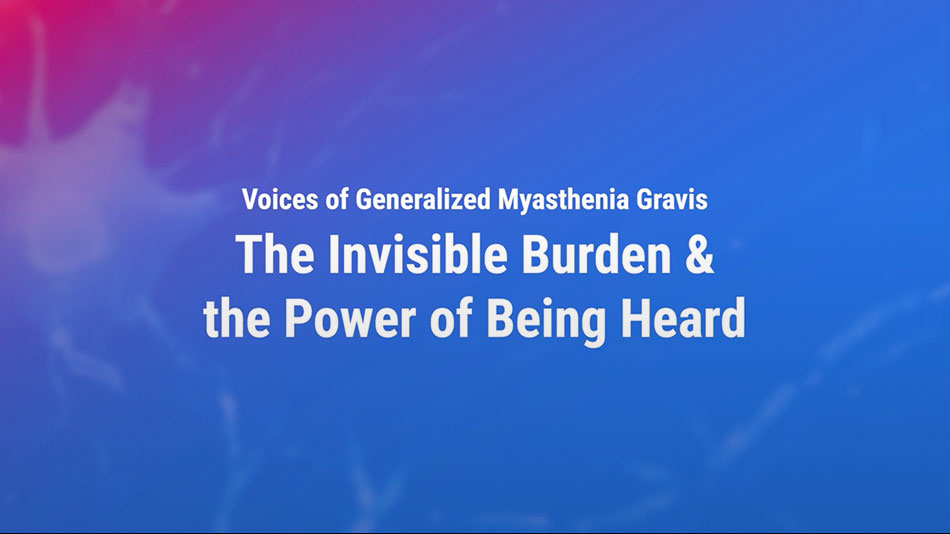
Voices of Generalized Myasthenia Gravis: The Invisible Burden and the Power of Being Heard
People with generalized myasthenia gravis (gMG) share what it’s like to navigate life with the disease, including their challenges and hope for the future.
.png)
Regeneron
May 29, 2026

“You feel mentally strong and you’re mentally there, but your body isn’t cooperating with you.”
-Jessica, living with gMG
Our muscles rely on signals from the brain – which are transmitted through nerves – to function properly. In myasthenia gravis (MG) this communication is disrupted when the immune system produces antibodies that interfere with the connection between nerves and muscles. Although MG is a rare disease, more than 80,000 people in the United States live with this condition.1 Initial manifestations are usually ocular, but approximately 85% of MG patients experience additional advancements to the disease manifestations, which is known as generalized myasthenia gravis (gMG).2 Living with MG often means navigating challenges that can touch nearly every aspect of daily life – from physical symptoms to the emotional and practical realities that come with managing a complex condition.
The Effect of Symptoms on Physical Health
MG causes extreme muscle weakness and fatigue that can worsen with activity. It can affect muscles throughout the body, including those that control facial expression and the ability to chew, swallow and speak. People living with MG may also experience weakness in the neck, arms and legs, making everyday tasks like holding up the head, lifting objects or walking more difficult. In more severe cases, the muscles involved in breathing can be affected. Symptoms can fluctuate over time and vary from person to person.3

“Within 5 minutes I was exhausted. I didn't want to do anything, and I had fatigue.”
-Pierre, living with gMG
The Challenging Diagnostic Journey
Diagnosing MG can be particularly challenging because symptoms are nonspecific and often resemble other conditions. Nearly one-third of people living with MG were initially diagnosed with a different condition, highlighting how easily it can be confused with other disorders.4 This is further complicated by the condition’s variability. Often referred to as a “snowflake disease,” no two patient journeys are exactly alike.3 Even high-tech diagnostic tools don’t always yield clear results. For some patients, it can take two years or more to receive an accurate diagnosis, which can postpone appropriate treatment and, in some cases, increase the risk of serious complications.4

“They sent me to just about everybody. Nobody really thought of myasthenia gravis.”
-Tina, living with gMG
The Impact on Mental Health and Everyday Life
Beyond its physical symptoms, MG can have a profound impact on emotional well-being and overall quality of life. Greater disease severity is associated with lower health-related quality of life, with higher rates of depression and anxiety reported among those with more severe symptoms. The effects of MG can also extend into professional life, where patients may experience reduced work productivity and increased time away from work. In some cases, patients face the need to reduce hours, leave the workforce or retire.5,6

“MG has affected my career by ending it.”
-Zach, living with gMG
The Need for More Research
There is currently no cure for MG. Existing treatments primarily focus on managing symptoms.1 While common approaches can help improve muscle strength for some patients, responses can vary widely, with some continuing to experience persistent symptom fluctuation. Many existing treatments can also come with challenges related to side effects, invasiveness and administration burden.7,8 Ongoing research, including at Regeneron, aims to advance our understanding of gMG.

“There’s a lot of research being done, so that gives me hope. Hope is critical.”
-Tom, living with gMG
Advocacy and Support
While scientific advances continue to shape the understanding and treatment of MG, the lived experiences of patients remain critical to fully grasping its impact. For many, the variability of symptoms and complexity of care make access to clear, relatable information and community support especially important. Patient advocacy organizations help bridge this gap by providing education, connecting individuals with shared experiences and empowering patients to engage more actively in their healthcare decisions. Check out the below independent patient advocacy organizations for more information*:

*The organizations listed are independent nonprofit organizations. Their inclusion here does not imply endorsement of Regeneron specific products.
References:
- Ye Y, Murdock DJ, Chen C, Liedtke W, Knox CA. Epidemiology of myasthenia gravis in the United States. Front Neurol. 2024 Feb 16;15:1339167. doi: 10.3389/fneur.2024.1339167. PMID: 38434198; PMCID: PMC10907989.
- Jinpin Li, Di Qiu, Zezhi Chen, Weiwei Du, Jingli Liu, Xuean Mo. Different molecular expression in thymoma with ocular or generalized myasthenia gravis. Journal of the Neurological Sciences, 2011; 313, 27-31. doi: 10.1016/j.jnd.2011.09.037.
- Myasthenia Gravis Foundation of America. What is Myasthenia Gravis. Accessed March 25, 2026. https://myasthenia.org/understanding-mg/what-is-myasthenia-gravis/.
- Vesperinas A, Rocaspana-Codana J, Reyes-Leiva D, et al. Challenges in myasthenia gravis diagnosis: an analysis of the diagnostic process of myasthenia gravis in a specialized clinic. Neuromuscular Disorders. 2025;59. doi: 10.1016/j.nmd.2025.106284.
- Marbin D, Piper SK, Lehnerer S, et al. Mental health in myasthenia gravis patients and its impact on caregiver burden. Sci Rep. 2022;12. doi: 10.1038/s41598-022-22078-3.
- Vitturi BK, Kim AIH, Mitre LP, et al. Social, professional and neurophysciatric outcomes in patients with myasthenia gravis. Neurol Sci. 2021;42(1):167-173. doi: 10.1007/s10072-020-04528-w.
- Myasthenia Gravis Foundation of America. Myasthenia Gravis Treatments. Accessed March 25, 2026. https://myasthenia.org/myasthenia-gravis-treatments.
- Schneider-Gold C. Hagenacker T, Melzer N, Ruck T. Understanding the burden of refractory myasthenia gravis. The Adv Neurol Disord. 2019;12. doi: 10.1177/1756286419832242.
Share this story


More Regeneron Stories
.jpg)
Research & Preclinical Development
A Mission Rooted in Neuroscience
Guided by a founding commitment, powerful insights and novel scientific approaches, we're aiming to address some of the most complicated conditions.
September 25, 2026
Navigating Metastatic Melanoma
A story of optimism, resilience and advocacy following a stage 4 melanoma diagnosis.
September 25, 2026

The Ins and Outs of Itch
Following the science of inflammation to break the cycle of itch and reduce the significant daily burden of skin diseases.
September 24, 2026