

How Student Math Research Connects to Modern Science
The Power of Proof: How One Student’s Math Breakthrough Connects to Modern Science.

Regeneron
July 27, 2026
Some of the most important advances in science don’t begin in a lab. They begin with a question—often one that has been asked for centuries.
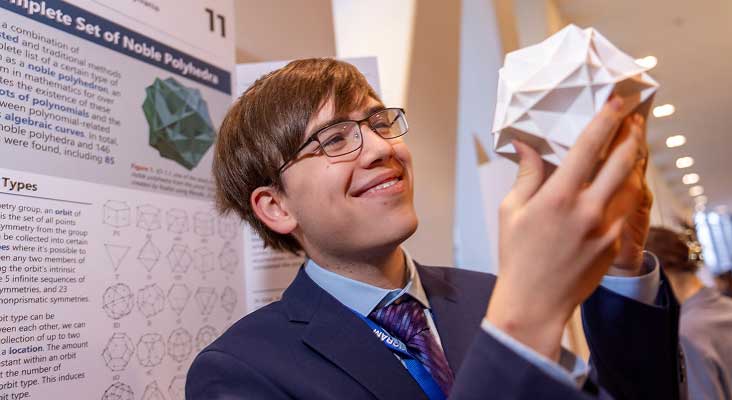
For Connor Hill, winner of the top award at the 2026 Regeneron Science Talent Search (STS), a program of the Society for Science, that question centered on a class of geometric objects known as noble polyhedra. These shapes are defined by symmetry and structure and rooted in mathematical traditions that trace back to Plato and the early study of geometry. What began as an open-ended geometric question ultimately led to a complete classification of noble polyhedra, identifying two infinite families along with 146 isolated examples.
At first glance, this kind of research may feel far removed from the work of developing new medicines. To explore how abstract mathematics connects to real-world discovery, Connor recently spoke with Henry Wei, MD, Executive Director, Development Innovation at Regeneron who is a physician-scientist working at the intersection of biology and medicine. As Connor looks ahead to attending MIT this fall, an opportunity supported partly through his winnings at Regeneron STS this year, their conversation brought a clearer connection into focus.
What links a centuries-old geometry problem to modern medicine is not the shape itself, but the mindset behind it. In both fields, researchers must turn complexity into something finite and solvable. That same approach underpins discovery in biology, medicine and beyond. Dr. Wei and Connor discuss how abstract mathematical ideas can drive real-world breakthroughs, and why curiosity-driven research continues to unlock what’s possible.
Q&A: Where Foundational Math Meets Clinical Science
Dr. Wei: Connor, what first sparked your interest in mathematics, and how did this research take shape?
Connor: I’ve been interested in math for as long as I can remember. A big part of that is patterns—once you start noticing them, you realize they show up everywhere. Math gives you a way to understand those patterns more deeply.
My Regeneron Science Talent Search project didn’t start as one big breakthrough. I was part of an online community exploring geometry, and I came across this question about noble polyhedra. At first, I thought I might find a few new examples, but over time, step by step, it grew into a full proof.
That’s how math usually works. It builds on what others have done, or what Newton described as “standing on the shoulders of giants.”

Dr. Wei: For those less familiar, what are noble polyhedra? Why have mathematicians been interested in them for so long?
Connor: They’re geometric shapes defined by symmetry. All the faces are identical, and all the vertices are identical. A cube is a simple example since every face, and every corner is the same. Noble polyhedra extend that idea, but they relax some of the stricter rules found in classical shapes like the Platonic solids.
What makes them interesting is this question of how much can you loosen the constraints while still preserving the structure.
Dr. Wei: Your work introduces the powerful idea of turning an “infinite” problem into a finite one. What does that mean in practice?
Connor: In geometry, there are often many possibilities. For example, there are infinitely many ways to arrange points in space. The challenge is figuring out how to reduce that to something manageable. I connected the geometric problem to algebra—specifically, to polynomials.

“By translating the problem into a different mathematical framework, I could narrow it down to a finite set that could actually be solved.”
Connor Hill
Connor: Dr. Wei, that idea of reduction feels central to scientific discovery. How do you see it show up in your work?
Dr. Wei: In biology and medicine, we’re constantly working with incredibly complex systems such as how proteins fold, how diseases progress, or how treatments interact with the body.
The challenge is making those systems understandable. When you can reduce complexity in a meaningful way, you move from approximation to something more precise. That’s where mathematics becomes essential. It gives us a way to focus on what actually matters.
Dr. Wei: Connor, you’ve said the methods behind your work may be more important than the result itself. Why is that?
Connor: A lot of mathematics ends up being useful in ways you can’t predict at the time. For this project, the key idea is connecting different areas of math like discrete geometry and algebraic geometry and using that connection to solve problems more effectively.
That kind of approach could apply to many different problems, anywhere you have structure, symmetry, or a large number of possibilities that need to be narrowed down.
Connor: Dr. Wei, can you share an example of how that kind of thinking applies to biomedical science?
Dr. Wei: One example is protein structure. Proteins can take on an enormous number of possible configurations, but only a small number are stable or biologically meaningful. The challenge is figuring out which ones matter.
Mathematics helps us reduce that complexity. Instead of trying everything, we can focus on a much smaller set of possibilities. That’s critical in areas like drug discovery.
Connor: Your conversation also touched on the idea of moving from approximation to exact solutions. Why does that matter?
Dr: Wei: In many areas of science today, especially with machine learning, we rely on approximation through models that can be very good, but never exact. Mathematics gives us another pathway. When you can describe a system precisely, you can sometimes solve it directly rather than estimate it.
That shift—from approximation to deeper understanding—is where breakthroughs can happen.
Dr. Wei: How do you think about the role of mathematics in solving larger challenges?
“Math is the language that makes scientific ideas usable.”
Connor Hill
Science gives us the concepts, but math allows us to formalize them and apply them. When we’re solving big problems, the key is breaking them into smaller pieces that math can address.
Often, breakthroughs happen when someone connects ideas across disciplines.
Dr. Wei: What advice would you give to future scientists?
Connor: Follow what you’re genuinely interested in. The most meaningful work comes from curiosity, not outcomes. Find people who share your interests and focus on small contributions—they build into something bigger over time.
Why Foundational Math Matters

Connor Hill’s work reflects a broader truth: scientific progress depends on simplifying complexity and connecting disciplines. That’s why we invest in future scientific innovators through STEM Fueled™.
Discover how STEM Fueled™ is advancing opportunities for the next generation of STEM innovators and learn more about our 2026 Science Talent Search winners.

Share this story


More Regeneron Stories
Tapping into Real-World Data for Positive Human Impact
Join us for the latest episode of The Nucleus, exploring how real-world data and genomic insights can improve health.
October 14, 2026
.jpg)
Research & Preclinical Development
A Mission Rooted in Neuroscience
Guided by a founding commitment, powerful insights and novel scientific approaches, we're aiming to address some of the most complicated conditions.
September 25, 2026

Navigating Metastatic Melanoma
A story of optimism, resilience and advocacy following a stage 4 melanoma diagnosis.
September 25, 2026