


Eye on the Experts: Reflections on a Roundtable
Trailblazing women in ophthalmology share insights, learnings, and professional advice.

Alena Reznichenko, MD, MSc, MBA
Vice President, Global Medical Affairs, Ophthalmology
March 09, 2026
Did you know that nearly 80% of the information we take in comes through our vision?1 It’s something most people take for granted or don’t realize unless they face vision-threatening diseases. For those of us working in ophthalmology, this is a reminder that helping to protect vision is more than an area of scientific focus. Research and innovation in this field can be transformative for people living with serious retinal diseases and their caregivers.
That is what drew me to become an ophthalmologist. Throughout my career, the potential to help patients maintain or improve their vision has given me a sense of purpose. And at Regeneron, I’m thrilled to be part of an organization with such a rich legacy of innovation in eye care science, where I’m surrounded by leaders who are helping to shape the bright future of the field. Collaborating alongside experts – within and outside of Regeneron – has underscored the importance of creating spaces where we can learn from one another to advance retina care.
With this focus in mind, we were honored to host a unique roundtable discussion spotlighting four trailblazing retina specialists to educate and inspire others in their professional journeys, including those who are just starting their careers.
These accomplished women shared valuable perspectives and professional advice on collaboration, mentorship, and the future of innovation in retina.
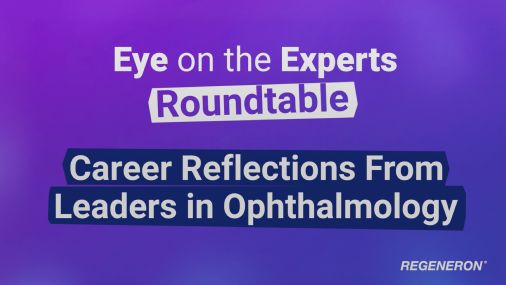
Watch this video to hear the full roundtable discussion
- Judy Kim, MD, FARVO, FASRS, Jean and Tom Walter Distinguished Chair in Ophthalmology in Honor of James P. McCulley, MD, Professor & Vice-Chair of Education, Medical Director of Clinical Research, UT Southwestern Medical Center, Dallas, TX
- Diana Do, MD, Professor of Ophthalmology, Vice Chair for Clinical Affairs, Byers Eye Institute, Stanford University School of Medicine
- Eleonora Lad, MD, PhD, Professor of Ophthalmology, Vice Chair of Ophthalmology Clinical Research, Duke University Medical Center
- April McCullough, MD, Senior Medical Director, Ophthalmology Medical Affairs, Regeneron
A few key themes arose from the discussion:
Collaboration
The group agreed that bringing a new therapy to patients never happens based on the work of one individual. And from what I’ve experienced personally, it truly takes a village. Advances in retina care rely on a broad ecosystem: clinicians, scientists, clinical-trial investigators, industry partners, patients, and caregivers, all contributing unique insights that shape the path forward.
Dr. Do captured this well, “We've seen through all of our scientific collaborations, how quickly we can develop a therapy for a patient. And that can't be done by a single person. It takes hundreds or thousands of clinician scientists to work together to benefit our patients.”
Mentorship and Networking
Although each physician described a unique professional path, their message was consistent: mentorship and networking matters at every stage, not just early on. Throughout my own journey, mentors have been essential; guiding me as I built my career in ophthalmology, transitioned into the pharmaceutical industry, and navigated new cultures around the world. Like Dr. Lad, I believe mentorship is rooted in a simple truth – one that is particularly important for women pursuing leadership positions – “we need to help everyone come up.”
Several of the women spoke about receiving guidance from unlikely sources—not just peers or department leaders, but sometimes early‑career colleagues whose fresh viewpoints reshaped their thinking.
“Nowadays even younger people are my mentors,” Dr. Kim commented. “I learn their special skills that I otherwise would not have gotten. So, age doesn't limit me. Gender does not limit me. And in fact, I recommend women to have many different mentors of both genders and make it broad, and as deep as possible so that you can learn from them.”
Innovation
There was a palpable sense of excitement about what’s possible for the future of retina care. Advances in treatment durability, gene therapy, AI-driven analytics, and next-generation imaging are steadily pushing the boundaries of what clinicians can achieve. As Dr. McCullough put it, the potential isn’t just in more personalized treatments, but in technologies that “free up time for doctors to spend with their patients and build meaningful relationships.”
Overall, the discussion reinforced a belief I hold deeply: innovation thrives where scientific curiosity, collaboration, and patient-centered thinking intersect. I’m proud to be part of a community that is so open to exchanging insights as we work toward our shared goal of improving the lives of people living with retinal diseases.
References
- Better Vision New Jersey. (2020, June 24). Keeping Your Essential Vision With Cataracts. https://bettervisionnj.com/keeping-your-essential-vision-with-cataracts/#:~:text=Science%20says%20that%2080%25%20of,our%20interactions%20with%20the%20world.
Share this story


More Regeneron Stories
.jpg)
Research & Preclinical Development
A Mission Rooted in Neuroscience
Guided by a founding commitment, powerful insights and novel scientific approaches, we're aiming to address some of the most complicated conditions.
September 25, 2026
.jpg)
At Regeneron, we’re in it for patients
Our colleagues reflect on how patients and their communities keep them in it for good. Each story is a powerful reminder of why the work we do to bring new medicines to people with serious diseases is so important, no matter how long it takes or how difficult the journey.
September 25, 2026
Navigating Metastatic Melanoma
A story of optimism, resilience and advocacy following a stage 4 melanoma diagnosis.
September 25, 2026