


Our Approach to Addressing a Growing Epidemic
Utilizing our deep expertise in human genetics and disease biology to take on MASH

Regeneron
October 30, 2026
You might not be familiar with MASH, but there's a growing chance someone you know has it. MASH stands for metabolic dysfunction-associated steatohepatitis, and impacts approximately 13 million U.S. adults.1-4
MASH is a more serious subtype within MASLD, or metabolic dysfunction-associated steatotic liver disease. MASLD is the buildup of excess fat in the liver (steatosis), which is often linked with common conditions such as obesity, type 2 diabetes and high blood pressure.5 It covers the whole spectrum, from simple fatty liver (fat with little or no inflammation) all the way up to more advanced disease. MASLD affects approximately one-third of all adults in the U.S. and most have the milder form and never progress further.1,3
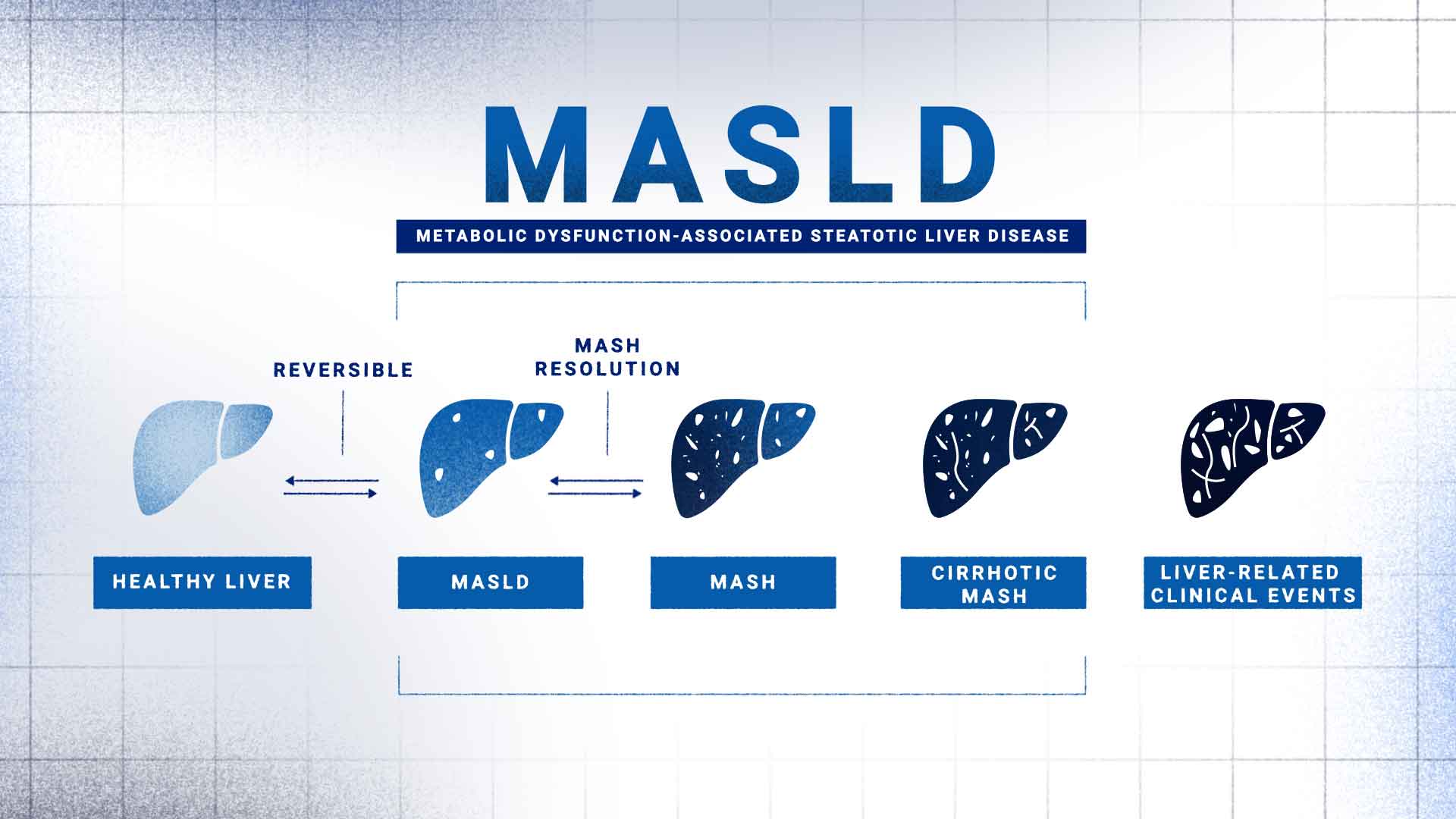
For some people, this excess fat in the liver can trigger inflammation and liver cell damage, leading to MASH. The inflammation can cause scarring of the liver (fibrosis) and, over time, this scarring can be so severe that it permanently alters the liver’s structure (cirrhosis). In the most serious cases, MASH can lead to liver cancer or even death.6
A few years ago, patients and physicians facing MASH were left with an empty toolkit, relying only on lifestyle changes to manage this silent, progressive liver disease. Fortunately, new scientific approaches are advancing our understanding of liver biology and have brought renewed hope to the community. At Regeneron, our scientists are working to help address liver disease through three key areas: advancing non-invasive biomarkers and digital pathology for improved diagnosis and prognosis, leveraging genetics to identify new targets, and conducting research to better understand and address MASH.
Alternatives to Biopsies: Streamlining the Process to Diagnosis
Starting with diagnosis, the biology behind MASH is complicated, and the “gold standard” method of diagnosing and assessing progression is through a liver biopsy: inserting a needle to remove a small piece of liver tissue for analysis. It's invasive, painful, and expensive – which is why there's a pressing need to advance non-invasive methods.
We are focusing on ways to make screening, diagnosing and monitoring patients less invasive and more scalable than traditional liver biopsies. That’s why we are partnering with academic investigators and other like-minded pharmaceutical and diagnostic companies in two public-private partnerships: NIMBLE (Non-Invasive Biomarkers of Metabolic Liver Disease) and MASHtrack (Tracking Liver Fibrosis and Outcomes Through Non-Invasive Prognostic Biomarkers in Patients with Metabolic Dysfunction-Associated Steatohepatitis), both led and managed by the Foundation for the National Institutes of Health (FNIH) Biomarkers Consortium. These efforts are aimed at finding and validating blood-based and imaging markers and thus far, some candidate markers have shown better accuracy than blood tests currently used. The next phase will explore whether combining several markers together works even better than using any single one. Separately, we are also exploring how measuring protein markers to develop a proteomics score could help improve identification of individuals at-risk for MASH and prediction of liver-related outcomes.
Bringing AI into the Picture
Our researchers are also working on making the analysis of biopsy samples better. That means using machine learning and AI tools to read liver tissue samples – instead of relying solely on a pathologist's eye. The hope is that these tools can reduce the natural variability that comes from different experts interpreting the same sample differently, while also speeding up how quickly results come back.
Genetic Discovery: DNA Sequencing Reveals Opportunity for Scientific Advancement
At Regeneron, we are drawing on our deep expertise in human genetics and disease biology, building upon a foundation in cardiometabolic research dating back to 2009, to identify potential disease targets and advance research in MASH.
We believe genomics has the potential to revolutionize how we approach drug discovery and development to find better ways to treat and prevent disease. At Regeneron Genetics Center® – one of the largest, most comprehensive genomic databases – we tap into our growing database of more than 3 million de-identified sequenced exomes linked with health records using proprietary data analytics, technology and human ingenuity to make meaningful biological discoveries at speed and scale.
Harnessing the power of human genetics, we analyzed de-identified molecular data and health records to identify overlaps between people who carry certain rare gene variants and who seem naturally protected from liver disease. Through our work, we’ve found that there are some variants that operate as natural, built-in safety shields against liver damage, including:
- CIDEB: As published in the New England Journal of Medicine (NEJM), we discovered a gene found in the liver that blocks the accumulation of fat.7 Data has shown that people with one mutated copy of this gene had approximately 22% lower liver fat, 35% lower odds of a MASLD or MASH diagnosis, and ~40% lower odds of MASLD-related cirrhosis.8
- HSD17B13: In a separate NEJM publication, we identified a liver-specific enzyme and protein that shields liver cells from advanced scarring. Data has shown that one mutated copy lowered liver disease risk by 17%; having two mutated copies lowered it by 30%.9
- PNPLA3: This gene of interest in liver disease is associated with increased hepatic triglyceride levels and an increased risk of MASH. RGC scientists found that the protective effects of the variants in HSD17B13 extend to individuals with the PNPLA3 mutation.9
Finding these variants has led to a powerful realization: if naturally reduced activity of a gene is associated with protection from disease, could science find a way to reproduce that effect?
From Discovery to Development: A Targeted Approach
Using our gene-silencing technology, our scientists are putting this theory to the test. Here’s how the science works:
DNA is a blueprint stored inside nearly every cell, which carries instructions for making proteins that get copied onto a messenger RNA (mRNA). We utilize small interfering RNA (siRNA) to recognize mRNA messages that could lead to the development of harmful proteins and intercept and destroy the messages before they can deliver their instructions – essentially silencing the gene's effects before the harmful proteins are ever made.
A Promising Future
MASH is quietly becoming one of the biggest looming health challenges tied to obesity and diabetes. Our researchers are attacking the problem from multiple angles at once. While much remains to be learned, these advances could reshape how MASLD and MASH are detected, monitored and ultimately treated.
References:
- Younossi ZM, Golabi P, Paik JM, et al. (2023). The global epidemiology of nonalcoholic fatty liver disease (NAFLD) and nonalcoholic steatohepatitis (NASH): A systematic review. Hepatology. 2023;77(4):1335–1347.
- Estes C, Anstee QM, Arias-Loste MT, et al. (2018). Modeling NAFLD disease burden in China, France, Germany, Italy, Japan, Spain, United Kingdom, and United States for the period 2016–2030. Journal of Hepatology, 69(4), 896–904.
- Le P, Tatar M, Dasarathy S, et al. (2025). Estimated Burden of Metabolic Dysfunction–Associated Steatotic Liver Disease in US Adults, 2020 to 2050. JAMA Network Open, 8(1), Article e2454707. https://doi:10.1001/jamanetworkopen.2024.54707.
- U.S. Census Bureau. (2025). Population Estimates, July 1, 2025 (V2025). Available from: https://www.census.gov/quickfacts/table/PST045215/21209%2C00. Last accessed: October 2026.
- American Liver Foundation. (2026). Metabolic Dysfunction-Associated Steatotic Liver Disease (MASLD). https://liverfoundation.org/wp-content/uploads/2026/08/MASLD-Fact-Sheet-2026.1.pdf.
- Cleveland Clinic. (2026). Metabolic Dysfunction-Associated Steatohepatitis (MASH). https://my.clevelandclinic.org/health/diseases/22988-nonalcoholic-steatohepatitis.
- Verweij, N., et al. (2022). Germline Mutations in CIDEB and Protection against Liver Disease. New England Journal of Medicine, 387(4), 334–344. DOI: 10.1056/NEJMoa2117872.
- Data on file.
- Abul-Husn NS, Cheng X, Li AH, et al. (2018). A Protein-Truncating HSD17B13 Variant and Protection from Chronic Liver Disease. New England Journal of Medicine, 378(12),1096-1106. https://doi:10.1056/NEJMoa1712191.
Share this story


More Regeneron Stories

Beyond the Diagnosis: Hope in NSCLC
Discover the human impact of NSCLC and how scientific innovation is redefining what’s possible for patients
November 13, 2026

10 Years of Impact Through Our Global Volunteer Initiative
As Day for Doing Good enters its second decade, we reflect on what it has meant to colleagues and communities.
October 19, 2026

Tapping into Real-World Data for Positive Human Impact
Join us for the latest episode of The Nucleus, exploring how real-world data and genomic insights can improve health.
October 14, 2026